


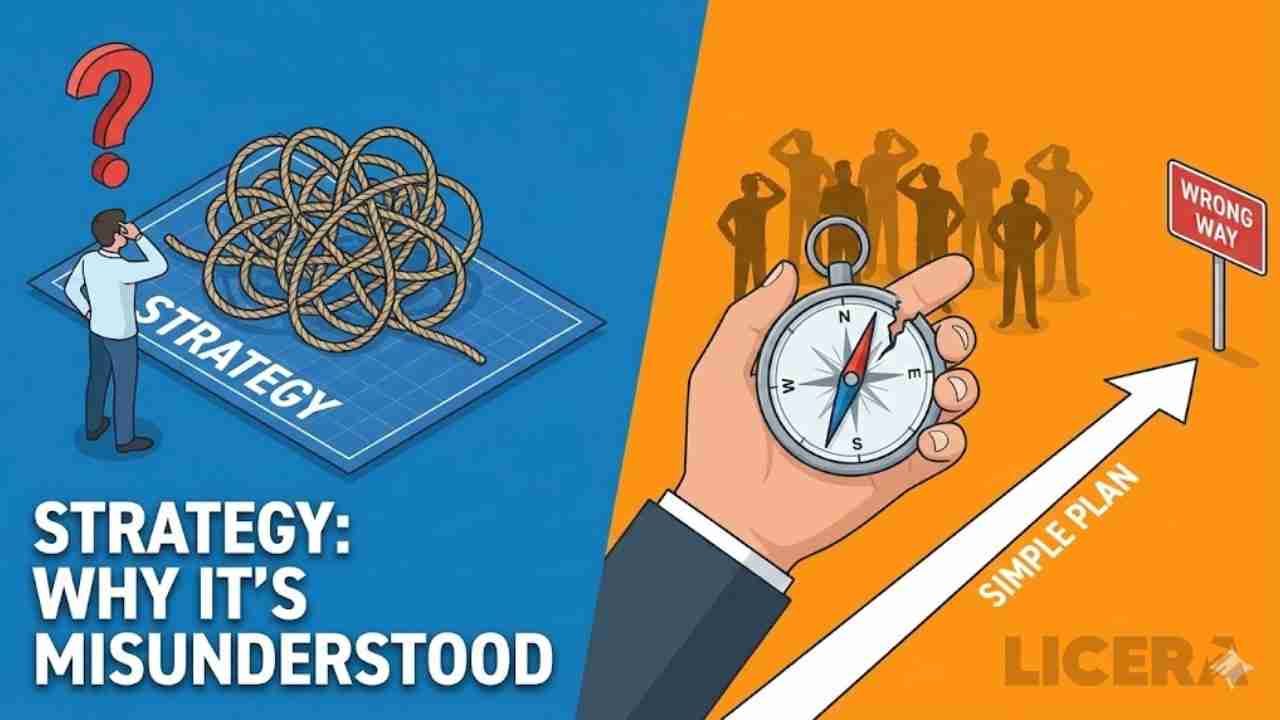
1.1 Understanding Why Strategy Is So Often Misinterpreted
Any meaningful discussion of strategy must begin by acknowledging a persistent misunderstanding: most organizations confuse strategy with ambition. They believe that declaring an inspiring destination is the same as constructing a strategic path. Yet, as Porter (1996, 1) clarifies, strategy is fundamentally about choosing what not to do.
This distinction matters because many leaders assume that greater effort, more planning sessions, longer documents, or ambitious mission statements automatically translate to strategy. In reality, these can obscure the discipline required to identify trade-offs and commit to direction. Strategy is less about dreaming big and more about deliberately narrowing focus so that action becomes intentional rather than reactive.
1.2 Strategy as an Act of Courage
Strategic choice is emotionally and politically difficult because it forces organizations to define boundaries. Every choice closes doors; every commitment requires rejecting alternatives. Leaders often resist these implications because rejecting options creates discomfort, introduces accountability, and risks disappointing internal and external stakeholders.
However, as industries accelerate, markets fluctuate, and institutional pressures multiply, the cost of avoiding choice has become larger than the cost of making one. Environments marked by volatility and technological disruption reward organizations that make bold strategic commitments, even when data is incomplete.
1.3 The Human Insight Behind Strategic Clarity
After more than twenty years advising governments, growing businesses, and social-impact organizations, one consistent pattern emerges: clarity is almost always more valuable than capacity. Organizations with modest budgets and sharp strategic focus routinely outperform well-funded but directionless competitors.
In practice, strategic clarity creates alignment, fuels execution, and accelerates decision-making. It gives teams permission to ignore distractions and concentrate resources where they matter most. Conversely, diffuse organizations—those juggling too many priorities—often collapse under their own ambition.
Strategic progress begins when leaders are honest about their limits and deliberate about their commitments. Courage, more than intelligence, often determines who succeeds.
1.4 Purpose and Intended Contribution of This Masterclass
The purpose of this paper is to provide a grounded, research-driven, practitioner-informed understanding of strategy that leaders can rely on amid uncertainty. It synthesizes decades of scholarship with front-line experience, highlighting strategy not as a theoretical abstraction but as the practical discipline of making consequential choices.
To build this foundation, the paper revisits the thinkers who shaped modern strategic thought and presents their ideas in a unified, accessible way. This literature foundation prepares the ground for examining strategy as a “kernel”: a diagnosis, a guiding policy, and a coherent set of actions.
Before reaching that framework, we examine the scholars whose work continues to influence strategic thinking worldwide.
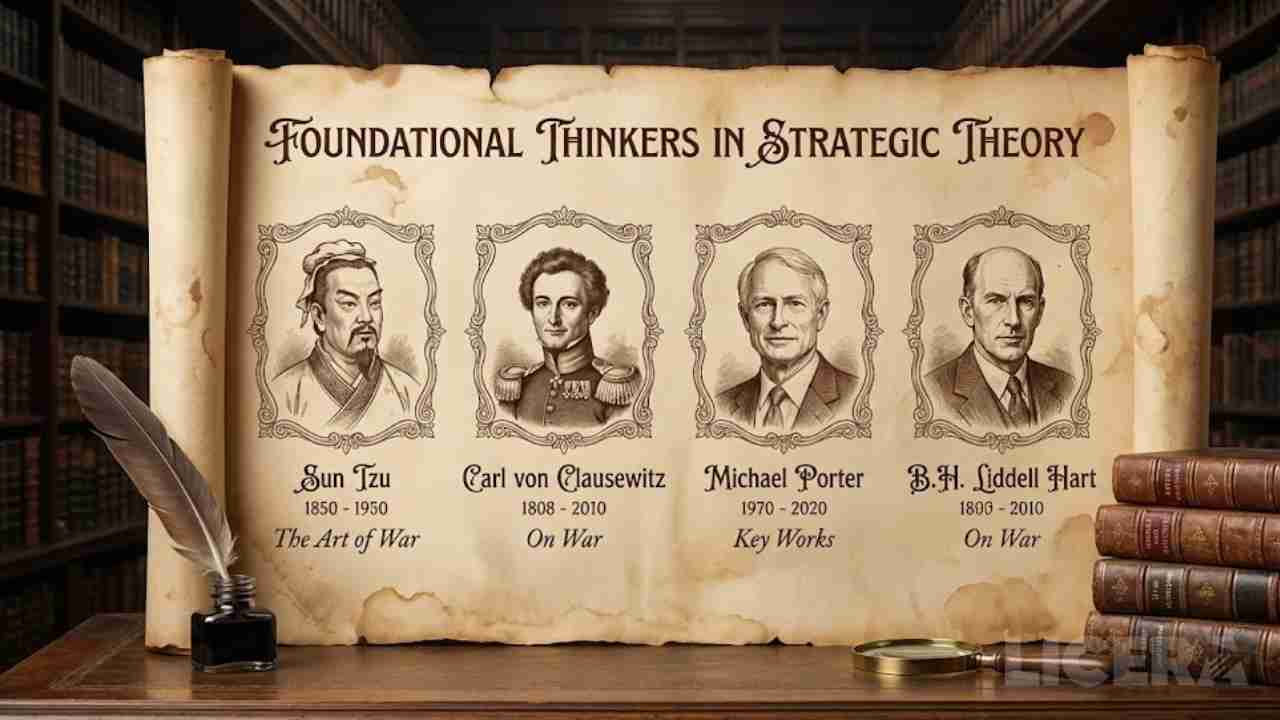
2.0 FOUNDATIONAL THINKERS IN STRATEGIC THEORY
2.1 Michael Porter: Strategy as Deliberate Positioning
Understanding Porter’s contribution is essential because he redefined strategy as the pursuit of a unique position supported by trade-offs. Before Porter, the popular assumption was that organizations could win by simply improving efficiency or increasing productivity. Porter (1996, 62) forcefully argues that operational effectiveness is necessary but insufficient; it cannot be strategy because it does not create defensible advantage.
Porter introduces three central principles:
- Strategy requires unique positioning;
- Strategy is protected by trade-offs;
- Strategy is sustained through activity fit, the alignment of complementary actions.
Southwest Airlines is the classic illustration. Every part of its operating model—from the single aircraft type to fast turnarounds—reinforces a low-cost position. The power lies not in individual activities but in the coherence of the system.
Porter’s work teaches leaders that without intentional sacrifice, differentiation collapses into imitation.
2.2 Richard Rumelt: The Structure of Good Strategy
Rumelt’s work is pivotal because he shifts attention from what strategy represents to how strategy works. He argues that many organizations produce “bad strategy” disguised as inspirational language, long goals lists, or vague performance targets. True strategy, Rumelt (2011, 76) asserts, must contain three tightly linked components:
- Diagnosis — an insight-driven interpretation of the core challenge;
- Guiding Policy — a high-level approach to handle the challenge;
- Coherent Action — a set of coordinated steps aligned with the policy.
A powerful example is Cisco’s post-2001 recovery. Instead of spreading itself thin across emerging markets, Cisco concentrated on core networking products—clarifying the challenge, choosing a policy, and aligning its actions. This clarity allowed the company to regain stability and reassert competitive advantage.
Rumelt’s structure remains one of the most practical analytical tools in modern strategy.
2.3 Henry Mintzberg: Strategy as Emergent Behavior
Mintzberg’s contribution begins with a challenge to one of the most deeply held assumptions in management—that strategy is something leaders plan, impose, and document. Mintzberg (1994) argues that strategy often arises organically from patterns of action rather than from formal planning processes.
He distinguishes between:
- Deliberate strategy, formed intentionally; and
- Emergent strategy, formed through adaptation, learning, and response.
Toyota’s global excellence emerged less from a single master plan and more from the cumulative refinement of its production system. This “pattern over time” perspective is crucial for leaders operating in unpredictable environments.
Mintzberg’s work reminds practitioners that strategy requires both discipline and humility: discipline to commit, and humility to adjust.
2.4 Hambrick & Fredrickson: Ensuring Strategy is Complete
Hambrick and Fredrickson address a common failure in strategic planning: incompleteness. Leaders often articulate a goal or differentiator without clarifying where they will compete, how they will scale, or what economic logic supports their position.
To resolve this, the Strategy Diamond offers five essential elements (Hambrick and Fredrickson 2001):
- Arenas — Where the organization will operate;
- Vehicles — How it will enter those arenas;
- Differentiators — What gives it advantage;
- Staging — The sequence and speed of moves;
- Economic Logic — How value and profit will be generated.
Netflix’s transformation demonstrates the diamond in practice: it knew which markets to enter, how to differentiate through technology and convenience, and which economic model would yield durable advantage.
This framework ensures that strategy is not a slogan but a system.
2.5 Lafley & Martin: Strategy as a Cascade of Choices
Lafley and Martin’s Playing to Win reframes strategy in managerial terms, making it accessible for leaders across sectors. Their approach centers on two primary choices—where to play and how to win—supported by the capabilities and systems required for success (Lafley and Martin 2013).
Their work at Procter & Gamble illustrates how strategic clarity produces organizational transformation. By focusing on categories where P&G could lead globally and building the necessary capabilities, the company outperformed competitors and revived its innovation engine.
This framework bridges the gap between theory and execution, showing strategy as a cascade of mutually reinforcing decisions.

3.0 SYNTHESIS OF STRATEGIC FOUNDATIONS
Although the perspectives of Porter, Rumelt, Mintzberg, Hambrick & Fredrickson, and Lafley & Martin differ, their collective work converges on a shared truth: strategy is a coherent, disciplined set of choices about how an organization will create and sustain value.
- Porter explains why trade-offs matter.
- Rumelt clarifies the architecture of strategy.
- Mintzberg reminds us that strategy evolves in practice.
- Hambrick & Fredrickson ensure the strategy is complete, not partial.
- Lafley & Martin demonstrate how leaders must translate choices into action.
Together, these foundations prepare us to explore the heart of this Masterclass—the anatomy of a strategic choice—which begins in Section 2 with the diagnosis of the strategic challenge.
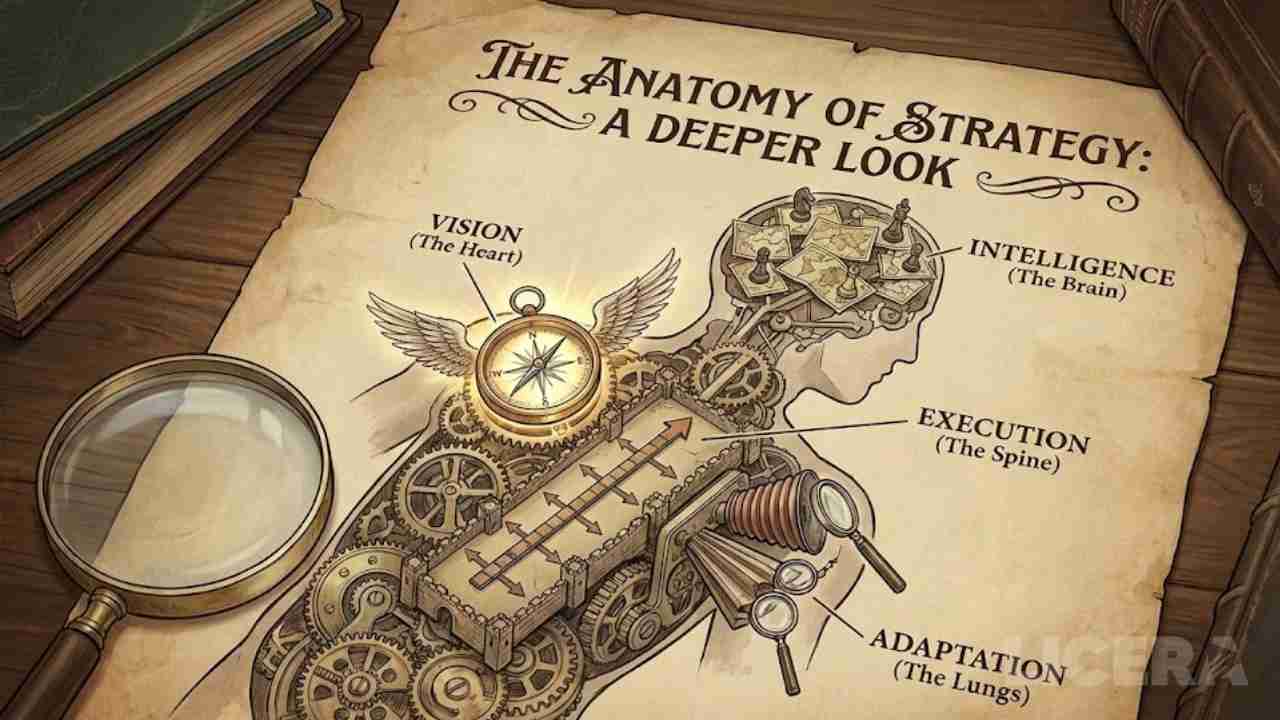
4.0 THE ANATOMY OF STRATEGY: A DEEPER LOOK
4.1 Why Strategy Must Begin With Its Smallest Powerful Unit
To make strategy usable rather than theoretical, it helps to break it down into its most essential parts. Rumelt (2011, 77) offers the clearest and most practical reduction of strategy into what he calls a “kernel”—a small but complete framework for making complex decisions actionable.
The kernel consists of three tightly linked components:
- Diagnosis: Clarifies the challenge.
- Guiding Policy: Sets the broad approach.
- Coherent Action: Aligns steps to make the policy real.
These components are simple to state but demanding to execute. The power of the kernel lies in its ability to transform strategy from a vague aspiration into a focused mechanism for change. Before exploring each component, it’s important to understand why the kernel remains relevant across industries and eras: it forces leaders to stop treating strategy as a slogan and start treating it as a decision architecture.
When leaders adopt this mindset, decision-making becomes clearer, teams gain direction, and organizations stop wasting energy on efforts that do not contribute to advantage.
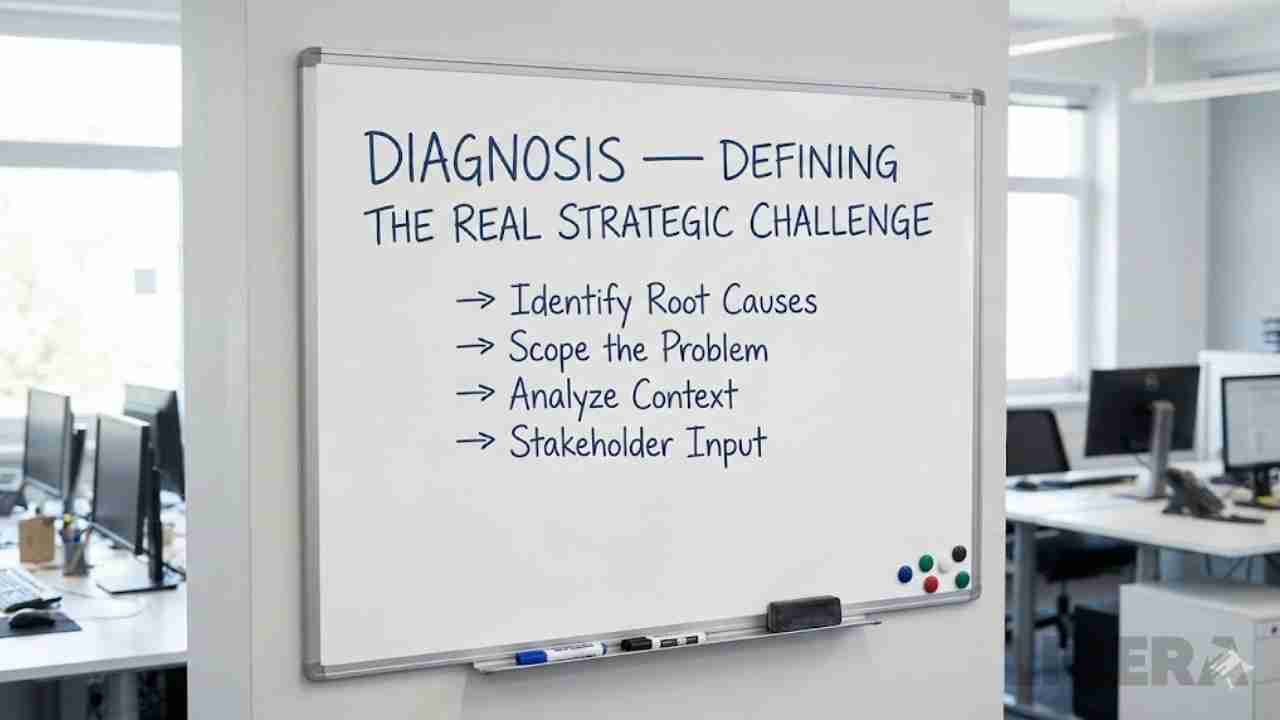
5.0 DIAGNOSIS — DEFINING THE REAL STRATEGIC CHALLENGE
5.1 Understanding What Diagnosis Really Means
A strategy is only as strong as the problem it attempts to solve. Diagnosis is the process of discovering and articulating the real challenge—one that is often hidden beneath symptoms, emotions, or political pressures. Rumelt emphasizes that poor diagnosis leads to poor strategy, regardless of resources or ambition (Rumelt 2011, 81).
Leaders frequently misdiagnose because they respond to visible symptoms rather than underlying dynamics. A company might blame competition for declining sales when the deeper issue is customer trust. A government may blame infrastructure gaps when the real challenge is slow institutional coordination. Misdiagnosis leads to misallocation.
Diagnosis is an act of intellectual honesty and analytical courage. It requires stepping back, seeing patterns, challenging assumptions, and naming uncomfortable truths. It is where strategy becomes real.
5.2 Human Dynamics Behind Misdiagnosis
Organizations often misdiagnose out of pride, fear, or habit. Teams may avoid confronting internal weaknesses. Leaders may cling to past successes. Executives may hesitate to question long-standing processes because doing so threatens identity or power structures.
This is why diagnosis is more than analysis—it is cultural. The best organizations encourage dissent, curious questioning, and data-driven reflection. The worst ones penalize honesty and reward denial.
5.3 Example: Netflix’s Early Diagnosis
Netflix recognized early that the threat was not Blockbuster but shifting consumer preferences and the coming rise of digital convenience. While competitors obsessed over retail distribution, Netflix diagnosed the deeper trend: behavior was moving online, and people wanted personalized access on demand.
This diagnosis determined everything that followed—their technology investments, licensing strategies, and content creation pivot.
5.4 Practitioner Insight
In years of advising organizations, the hardest part of diagnosis is helping teams accept what they already know but have been avoiding. The real challenge is rarely a mystery; it is usually a sensitive truth—internal delays, capability gaps, inconsistent leadership, or misaligned priorities. When teams finally name the real problem, momentum begins. Decisions get clearer. Strategy becomes possible.
5.5 Closing Thought on Diagnosis
Diagnosis sets the stage for everything else. Without it, strategy becomes noise. With it, strategy becomes a tool for transformation. The next step—creating a guiding policy—depends entirely on the clarity established here.

6.0 GUIDING POLICY — THE STRATEGIC APPROACH THAT SHAPES BEHAVIOR
6.1 Why Guiding Policy Matters
Once the problem is defined, leadership must select an overarching approach to address it. The guiding policy provides the orientation, boundaries, and logic that inform every subsequent decision. Rumelt (2011, 91) argues that an effective guiding policy balances focus with flexibility—it constrains choices without dictating every detail.
A guiding policy is not an action plan. It is the philosophy of how the organization intends to win.
6.2 Characteristics of an Effective Guiding Policy
The best guiding policies share several qualities:
- Focus: They clearly define what matters most.
- Feasibility: They reflect available capabilities.
- Differentiation: They leverage unique strengths.
- Boundaries: They specify what the organization will avoid.
A strong guiding policy helps leaders and teams make decisions quickly because it filters out distractions. It acts as a compass rather than a map.
6.3 Example: Singapore’s Long-Term Guiding Policy
Since the 1960s, Singapore operated under a consistent guiding policy: win through trust, efficiency, safety, and talent—not geography or resources. This policy led to decades of interconnected choices in education, governance, infrastructure, and diplomacy.
Its power lies in consistency. Over time, guiding policies shape identity.
6.4 Practitioner Insight
In strategy work, the guiding policy is often where leadership maturity becomes visible. Leaders who seek universal approval struggle to commit to a clear stance, resulting in vague policies that confuse teams. But leaders who commit—those who choose a direction and accept the consequences—unlock coherence and speed.
The guiding policy is where organizations declare, “This is who we will be,” and equally, “This is who we will not be.”
6.5 Closing Thought on Guiding Policy
Guiding policies give organizations strategic identity. They turn diagnosis into direction. Yet even the best guiding policies remain theoretical until expressed through coherent action—the final component of the kernel.

7.0 COHERENT ACTION — WHERE STRATEGY BECOMES REAL
7.1 The Purpose of Coherent Action
Coherent action is the practical expression of strategy. It refers to a set of mutually reinforcing steps that operationalize the guiding policy. Unlike tactical checklists, coherent actions must fit together in a way that produces momentum (Porter 1996, 70).
In other words: coherence amplifies impact. Disconnected initiatives, no matter how impressive individually, dilute effort.
7.2 What Coherence Looks Like
Coherent action means:
- Actions support the policy, not contradict it.
- Resources flow to the priorities that matter most.
- Activities align across departments rather than compete.
- Systems and culture reinforce strategic direction.
Organizations that succeed at coherent action create synergy—progress in one area strengthens progress in another.
7.3 Example: Toyota’s Integrated System
Toyota’s production model is a masterclass in coherence. Its guiding philosophy—quality, reliability, and continuous improvement—is supported by just-in-time processes, decentralized problem-solving, standardized work, and a culture of respect.
Everything aligns. Nothing contradicts. This is coherence.
7.4 Practitioner Insight
The most common barrier to coherent action is institutional inertia. Teams want to keep beloved programs, pet projects, or legacy initiatives—even when these no longer support strategic direction. Real coherence often requires subtraction, not addition. Removing misaligned work is where strategy becomes visible.
Coherent action is also where leadership earns trust. People follow leaders who align words with actions. When strategy translates into consistent behavior, alignment deepens and execution accelerates.
7.5 Closing Thought on Coherent Action
Coherent action transforms strategy into reality. It is the culmination of diagnosis and guiding policy. Without coherent action, strategy is simply intent. With it, strategy becomes capability.

8.0 TRADE-OFFS — THE STRATEGIC COURAGE TO CHOOSE
8.1 Why Trade-Offs Give Strategy Its Shape
Strategy becomes meaningful only when leaders make decisions that exclude alternatives. Porter (1996, 68) argued that trade-offs give strategy its identity because they force organizations to define boundaries. This clarity allows teams to focus, resources to flow appropriately, and differentiation to emerge.
Most organizations struggle not because they lack opportunities, but because they lack the discipline to prioritize. Without trade-offs, everything feels urgent; with them, only the important survives.
8.2 The Human Discomfort Behind Strategic Sacrifice
Trade-offs are psychologically difficult. Behavioral science shows humans instinctively avoid loss (Kahneman 2011). Leaders often hesitate to discontinue legacy programs or politically sensitive initiatives. Organizations may cling to outdated commitments out of nostalgia or fear of backlash.
Yet the unwillingness to choose leads to diluted strategy. When teams try to support every demand, they end up excelling at none.
Strategic maturity begins when leaders recognize that saying “no” is an investment in excellence elsewhere.
8.3 Strategic Trade-Offs in High-Performing Organizations
Some of the world’s best-performing institutions became exceptional because they embraced the disciplines of sacrifice:
- IKEA sacrifices customization to deliver low prices and logistical efficiency.
- Singapore Airlines emphasizes service excellence over price competition.
- Southwest Airlines avoids global expansion to maintain rapid, reliable domestic operations.
- Apple prioritizes ecosystem control over platform openness.
They win by being different, not by trying to be everything.
8.4 Practitioner Insight
Across twenty years of advisory work, I’ve seen organizations transform dramatically after making one courageous choice: the decision to stop doing what no longer serves their purpose. Whenever leaders gain the courage to articulate what the organization will no longer pursue, alignment accelerates and morale improves.
Teams thrive when expectations become clear, resources become focused, and distractions fade. Clarity is energizing.
8.5 Transition
Trade-offs protect strategic focus, but their ultimate purpose is to strengthen the organization’s ability to create value—the cornerstone of any serious strategy.

9.0 VALUE CREATION — THE PURPOSE BEHIND EVERY STRATEGIC CHOICE
9.1 Why Value Creation Defines Strategic Success
Strategy is only as useful as the value it creates. Whether an organization serves customers, citizens, or communities, value is the measure that justifies investment. Brandenburger and Nalebuff (1996) reinforce that sustainable advantage arises when organizations provide meaningful benefits that alternatives cannot match or replicate.
Value is not defined solely by profit—it may be trust, safety, experience, dignity, or access. Strategy should define which value matters most and how it will be delivered.
9.2 Creating Value Through Differentiation
Differentiation is not about offering more; it is about offering meaningfully different value. Porter (1980) argues that advantage comes when organizations exceed expectations in certain dimensions while intentionally reducing emphasis elsewhere.
Differentiation may come from:
- Service excellence (e.g., Singapore Airlines)
- User experience (Apple)
- Operational performance (Toyota)
- Personalization and convenience (Netflix)
- Reliability and consistency (Toyota Production System)
Value intensifies when organizations focus on the dimensions that truly matter to their stakeholders.
9.3 Value Through System-Level Coherence
True value creation is systemic, not isolated. Netflix succeeds not because of one capability, but because of the interplay between its data algorithms, content library, streaming infrastructure, device partnerships, and consumer interface.
Likewise, Toyota’s global reputation emerges from decades of coherent actions anchored in lean manufacturing, continuous improvement, and empowered workforce culture (Senge 1990).
Systems—not slogans—create lasting value.
9.4 The Human Dimension of Value
For governments and social-impact organizations, value is deeply human. It may mean:
- Faster, more reliable public services
- Greater safety and disaster readiness
- Inclusive programs that uplift marginalized communities
- Transparent governance that earns trust
- Access to education, healthcare, or opportunity
Strategic value improves lives—not just metrics.
9.5 Transition
While value creation is the goal, achieving it depends on leadership mindset. Strategy requires thinking differently about complexity, time, and behavior. This is where the strategic mindset comes in.

10.0 THE STRATEGIC MINDSET — HOW HIGH-LEVEL LEADERS THINK
10.1 Why Mindset Determines Strategic Effectiveness
Even the best strategic frameworks fail without the right cognitive habits. Leaders must excel not just at planning but at perceiving patterns, organizing complexity, and communicating intent. A strategic mindset transforms frameworks into action.
The strategist’s job is not to predict the future perfectly but to make directionally correct decisions consistently. This separates strategic leadership from reactive management.
10.2 Core Traits of Strategic Thinkers
Decades of research and practice reveal consistent traits among effective strategists:
- Systems Thinking: Seeing interconnected causes and ripple effects (Senge 1990).
- Courageous Decision-Making: Acting without needing perfect certainty.
- Focus Discipline: Choosing and protecting priorities amidst noise.
- Bias Awareness: Recognizing cognitive distortions (Kahneman 2011).
- Narrative Clarity: Translating strategy into compelling, actionable stories.
- Long-Term Perspective: Ensuring decisions survive beyond short-term pressure.
These traits are not innate; they are cultivated through experience, humility, and reflection.
10.3 Cultures That Enable Strategic Thinking
Strategy thrives in cultures where:
- dissent is safe,
- data challenges assumption,
- reflection is valued, and
- learning is continuous.
Organizations that silence honest insight, reward conformity, or punish questioning inevitably weaken their strategic capacity.
Strategic thinking is not a personal skill—it is an organizational ecosystem.
10.4 Practitioner Insight
Across many engagements—from public sector reforms to corporate transformations—the turning point almost always comes when leaders shift from reactive patterns to proactive clarity. The moment a leadership team begins to think systematically, prioritize courageously, and communicate consistently, strategy accelerates.
Disciplined thinking precedes disciplined action.
With the mechanics and mindset now established, strategy can be understood in its totality: a discipline that blends clarity, courage, coherence, and value creation.

11.0 CONCLUSION — STRATEGY AS THE DISCIPLINE OF COURAGEOUS CHOICE
11.1 Integrating the Full Anatomy of Strategy
Strategy is the sum of interconnected choices. Diagnosis shapes understanding. Guiding policy defines direction. Coherent action operationalizes intent. Trade-offs protect focus. Value creation justifies the effort. And the strategic mindset ensures continuity, adaptability, and discipline.
When these components align, organizations become not only more effective but more resilient.
11.2 The Human Work Behind Strategy
Strategy is a deeply human endeavor. It demands intellectual honesty, emotional courage, and the willingness to confront uncertainty with clarity. The best strategies do not emerge from perfect data; they emerge from committed leadership.
11.3 Personal Note From Ruben Licera
Throughout my career in strategy, I’ve learned that clarity is transformative. The greatest breakthroughs I’ve witnessed—whether in government reforms, social programs, or corporate turnarounds—came when leaders chose direction with conviction. Strategy becomes life-changing when it aligns people’s energy, institutions’ strengths, and communities’ needs.
Clarity is more than a plan—it is a service to the people you lead.
11.4 Final Sign-Off
— Ruben Licera
Global Marketing Strategist & Guerrilla Marketing Pioneer
Cebu, Philippines
12.0 REFERENCES
Brandenburger, Adam, and Barry Nalebuff. 1996. Co-Opetition. New York: Doubleday.
https://www.penguinrandomhouse.com/books/17522/co-opetition-by-adam-m-brandenburger-and-barry-j-nalebuff/
Hambrick, Donald C., and James W. Fredrickson. 2001. “Are You Sure You Have a Strategy?” Academy of Management Executive 15 (4): 48–59.
https://www.jstor.org/stable/4165744
Kahneman, Daniel. 2011. Thinking, Fast and Slow. New York: Farrar, Straus and Giroux.
https://us.macmillan.com/books/9780374533557/thinkingfastandslow
Lafley, A.G., and Roger L. Martin. 2013. Playing to Win: How Strategy Really Works. Boston: Harvard Business Review Press.
https://store.hbr.org/product/playing-to-win-how-strategy-really-works/10379
Mintzberg, Henry. 1994. The Rise and Fall of Strategic Planning. New York: Free Press.
https://www.simonandschuster.com/books/The-Rise-and-Fall-of-Strategic-Planning/Henry-Mintzberg/9780029216057
Porter, Michael E. 1980. Competitive Strategy: Techniques for Analyzing Industries and Competitors. New York: Free Press.
https://www.simonandschuster.com/books/Competitive-Strategy/Michael-E-Porter/9780684841489
Porter, Michael E. 1996. “What Is Strategy?” Harvard Business Review 74 (6): 61–78.
https://hbr.org/1996/11/what-is-strategy
Rumelt, Richard. 2011. Good Strategy/Bad Strategy: The Difference and Why It Matters. New York: Crown Publishing.
https://www.penguinrandomhouse.com/books/201879/good-strategy-bad-strategy-by-richard-rumelt/
Senge, Peter. 1990. The Fifth Discipline: The Art and Practice of the Learning Organization. New York: Doubleday.
https://www.penguinrandomhouse.com/books/309026/the-fifth-discipline-by-peter-m-senge/


